For many people living with chronic low back pain, the experience is frustratingly familiar: imaging shows “degenerative changes,” physical therapy hasn’t provided lasting relief, and no one has clearly explained what’s actually causing the pain. You may have been told your MRI shows issues with discs, joints, or general “wear and tear,” but without a clear connection between those findings and your symptoms, it can feel like you’re stuck managing pain without a real plan forward.
One increasingly recognized source is vertebrogenic pain, a specific type of back pain that originates within the spine itself, not the muscles or discs. For many patients, this explains why treatments aimed at muscles or discs haven’t provided lasting relief.
At Goodman Campbell Brain and Spine, we frequently see patients with vertebrogenic low back pain who have been searching for answers for months or even years. Many come to us after trying multiple rounds of conservative care, often feeling uncertain about what their diagnosis really means or whether surgery is their only option. The good news is that this condition is now better understood, opening the door to more precise diagnosis, clearer explanations of symptoms, and treatment options that focus on the root cause rather than simply managing pain.
What Is Vertebrogenic Pain?
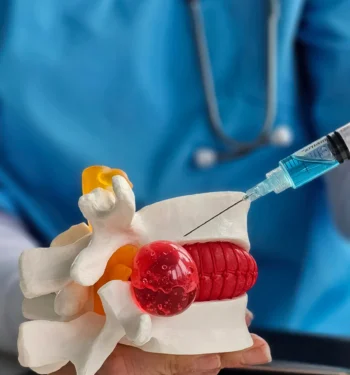
Vertebrogenic pain is a form of chronic low back pain that originates from damage to the vertebral endplates. These are thin, nerve-rich layers of bone that sit between the vertebrae and the spinal discs.
These endplates are plentiful in nerves, particularly the basivertebral nerve, which transmits pain signals from inside the vertebrae. When the endplates become damaged, often due to everyday wear and tear, they can become inflamed and sensitized. Over time, this leads to persistent pain signals that traditional treatments may not address.
This is a relatively newer clinical concept, but it has significantly changed how specialists approach patients with chronic back pain that hasn’t responded to conventional care.
How Is Vertebrogenic Pain Different From Disc Pain or Muscle Pain?
Not all back pain comes from the same source, as demonstrated in the following variations:
- Disc-related pain typically involves herniation or degeneration that may compress nearby nerves.
- Muscle pain is more surface-level and often improves with rest or physical therapy.
- Vertebrogenic pain, by contrast, originates within the vertebral bone itself, specifically the endplates and basivertebral nerve.
Because of this, vertebrogenic pain often does not respond to treatments that target discs, joints, or muscles. It’s also possible to have disc degeneration and vertebrogenic pain at the same time, but they are distinct pain generators requiring different strategies.
What Causes Vertebrogenic Pain?
The most common cause is gradual degeneration from everyday wear and tear on the spine.
As spinal discs lose hydration and height over time, more mechanical stress is transferred to the adjacent vertebral endplates. This can lead to:
- Micro-damage within the endplates
- Ongoing inflammation
- Sensitization of the basivertebral nerve
- Persistent pain signals
Contributing factors may include repetitive loading, prolonged sitting, poor posture, or a prior back injury. Because the onset is often gradual, vertebrogenic low back pain is frequently mistaken for general disc degeneration or nonspecific chronic back pain.
What Are the Symptoms of Vertebrogenic Pain?
Vertebrogenic pain has a distinct pattern, which includes:
- A deep, aching, or burning pain in the lower back along the midline of the spine
- Minimal or no radiating pain into the legs
- A dull, constant baseline discomfort with occasional flares
Many patients notice that symptoms worsen with:
- Prolonged sitting
- Bending forward
- Transitioning from sitting to standing
- Physical activity
The absence of leg pain is an important clue, helping distinguish vertebrogenic pain from nerve compression or disc herniation.
Why Does Vertebronic Pain Get Worse When You Sit or Bend Forward?
Sitting and forward bending increase pressure on the front portion of the spine, particularly the vertebral bodies and endplates.
When these structures are damaged and inflamed, this added load intensifies the pain signals being transmitted through the basivertebral nerve. This positional pattern is clinically important and helps differentiate vertebrogenic pain from other causes, such as facet joint or sacroiliac joint pain.
How Is Vertebrogenic Pain Diagnosed?
A clear vertebrogenic low back pain diagnosis requires more than imaging alone; rather, it requires correlation between symptoms and findings.
The process typically includes:
- A detailed medical history and physical exam
- Evaluation of movement patterns, especially flexion-based pain
- Imaging, most commonly an MRI for back pain
The key imaging finding is Modic changes on MRI. These are signal changes in the vertebral endplates and nearby bone marrow that indicate inflammation or degeneration.
Important points to note include the following:
- No blood test can diagnose vertebrogenic pain.
- X-rays alone are not sufficient.
- Other causes (disc herniation, joint pain, etc.) must be ruled out.
This is where specialist evaluation becomes critical. Our team focuses on identifying the true pain generator before recommending any treatment.
What Do Modic Changes on an MRI Mean for Your Diagnosis?
Modic changes are MRI findings that reflect changes in the vertebral endplates and surrounding bone.
There are two common types:
- Type 1: Active inflammation
- Type 2: Fatty degeneration
When Modic changes align with a patient’s symptoms, they strongly suggest that the vertebral endplates, not the discs or joints, are the primary source of pain.
That said, not everyone with Modic changes will have vertebrogenic pain. This is why clinical context matters, and why working with a back pain specialist who understands these nuances is so important.
What Are the Treatment Options for Vertebrogenic Pain?
Treatment follows a stepwise approach, with a focus on helping patients find relief by addressing the underlying cause, not masking symptoms.
Conservative Care
Initial approaches may include:
- Targeted physical therapy focused on spinal support and stability
- Activity modification to reduce stress on the spine
For some patients, these strategies are enough. However, if symptoms persist for at least six months, more advanced options may be considered.
Interventional Approaches
When conservative care falls short, interventional pain management services become an important next step within comprehensive interventional spine care — often as part of a broader set of non-opioid alternatives for chronic back and nerve pain.
These treatments focus on the nerve pathways responsible for pain, not on structural compression. They can help to confirm diagnosis and reduce pain signals, but they do not remove compression from discs or nerves. If you’re considering this route, it helps to understand what to expect afterward, including potential side effects.
When Is Basivertebral Nerve Ablation the Right Option?
For patients with confirmed vertebrogenic pain, one of the most targeted options is basivertebral nerve ablation, commonly known as the Intracept® procedure.
This is a minimally invasive spine treatment in which radiofrequency energy is used to interrupt the basivertebral nerve inside the affected vertebra. By stopping the transmission of pain signals, many patients experience meaningful and lasting relief.
Key points about Intracept® include the following:
- It is an FDA-cleared spine treatment.
- It is performed as an outpatient procedure.
- It does not alter spinal structure or remove compression (in contrast to spinal fusion), instead addressing the nerve-level source of pain.
- It is specifically designed for vertebrogenic low back pain.
Typical candidates include patients who:
- Have chronic low back pain lasting at least six months
- Show Modic changes on MRI
- Have not improved with conservative care
When Does Vertebrogenic Pain Require Neurosurgical Evaluation?
Vertebrogenic pain itself does not require surgery. However, some patients also have structural issues such as disc herniation, instability, or nerve compression that may require surgical consideration. A minimally invasive spine procedure called Intracept® can be an alternative course of action.
In these cases, a neurosurgeon for back pain plays a critical role.
At Goodman Campbell, our neurosurgeons receive more extensive and specialized training in the brain, spine, and nervous system than any other type of specialist, including orthopedic surgeons. This allows us to collaborate with our interventional pain management physicians to evaluate both interventional and surgical pathways with precision.
If structural pathology is present, procedures such as microdiscectomy may be appropriate, not for vertebrogenic pain itself, but for coexisting conditions involving discs or nerves.
A More Complete Path to Diagnosis and Relief
One of the biggest challenges in chronic low back pain is uncertainty, particularly when it comes to not knowing what’s causing your symptoms or what to do next.
Our approach at Goodman Campbell is different. We prioritize:
- Accurate, root-cause diagnosis
- Clear explanations of what your MRI actually means
- Access to interventional pain management and neurosurgical spine expertise
- Direct communication with your care team
- Prompt, accessible scheduling
As a global leader in treating spine conditions and an epicenter of neurosurgery training and spine innovation in the United States, we’re equipped to treat both straightforward and complex cases, all in one place.
Take the Next Step
If you’ve been living with chronic back pain and still don’t have clear answers, it may be time for a more specialized evaluation.
Request an appointment to see a spine specialist who can help you better understand your diagnosis and explore the right treatment options for you.