Life can throw you a curveball, or in the case of former Indiana Miss Basketball and WNBA player Vicki Hall, it can hit you with a series of stealthy crossovers that show you, in Hall’s words “just how fragile but also how powerful the human body can be.” It’s difficult to fathom, but between 2018 and 2025, Hall experienced three ischemic strokes.
“Each one changed me, physically and emotionally, and forced me to rebuild not only my strength but also my sense of purpose,” she says. Today, she wants to use her experience for good. “I want to contribute to society. That’s what life is all about.”
Krishna Amuluru, MD, is the Goodman Campbell interventional neuroradiologist who treated Hall after her most recent stroke in 2025. He and Molly Matthews, DNP, FNP-C, credit Hall’s motivation and discipline, especially as a former professional athlete, for how well she has recovered and how much she will likely continue to progress.
A career built around basketball
Hall was born with a genetic disorder called Lamin A/C that weakens the heart and leads to AFib, an irregular heartbeat that increases the risk of stroke. Her father passed away when he was just 46. “It’s a miracle that I’m talking to you,” she says.
In spite of her genes, as a young woman, Hall accumulated 1,725 points playing basketball at Brebeuf High School in Indianapolis and was named National Player of the Year by Parade Magazine in 1988. She went on to excel at the University of Texas at Austin from 1988-1993 — where she’s in UT’s Hall of Honor.
She won gold as part of the 1990 FIBA World Championship for Women and the 1990 Goodwill Games with the American women’s basketball team. And in 2000, she joined the Women’s National Basketball Association, playing for the Cleveland Rockers, Indiana Fever and Los Angeles Sparks.
As Hall bounded up and down the court, no one watching or trying to keep her from the basket would have guessed she was playing with a weakened heart. She was playing to win. Her WNBA career included 61 games up to 2002 and 255 points. Hall was inducted into the Indiana Basketball Hall of Fame in 2013.
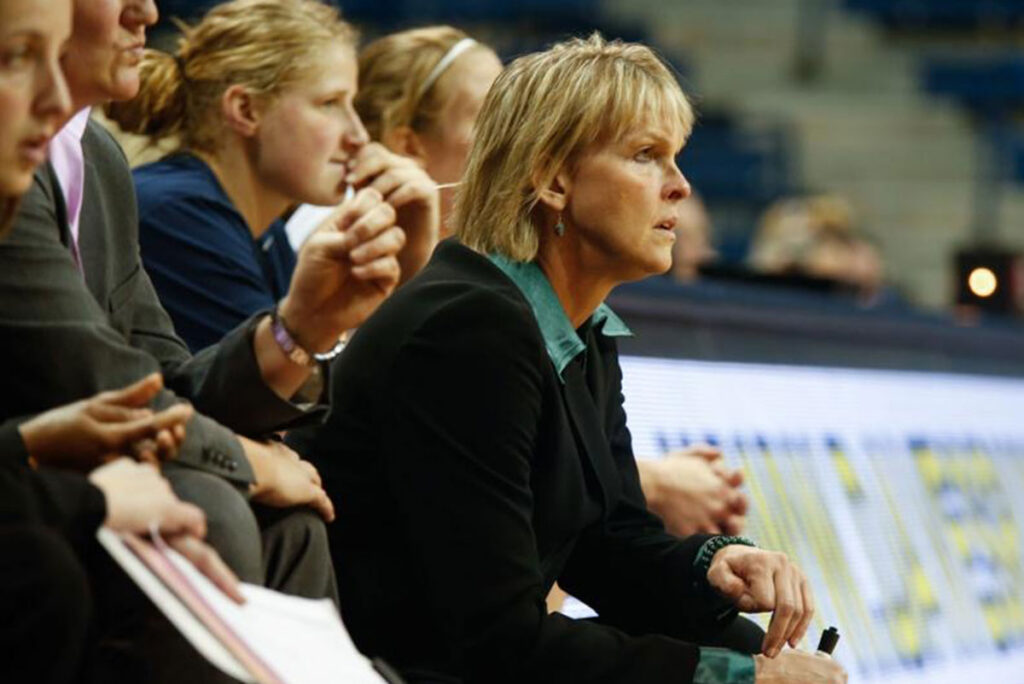
After her career as a player came to an end, she transitioned into coaching, first as an assistant at Miami University and then the University of Toledo before returning to her home state in 2018 to be the head coach at Indiana State University.
Hall had her first stroke when she was working in Terre Haute. She was in the middle of a conversation and suddenly found herself unable to talk. Then she tried to lift her right hand, but it wouldn’t move. Hall’s symptoms lasted two minutes and then they were over. Doctors diagnosed the episode as a stroke, and there were no long-lasting impacts.
When a position on the coaching staff at the Indiana Fever came up in 2021, Hall took it. She coached the WNBA team for two years and was inducted into the Indiana Sports Hall of Fame in 2023.
Hall’s second stroke came a year later, again without warning. She was in her kitchen and accidentally slid a plate off the counter. When she tried to pick it up, she couldn’t. Her partner, Kerri Wilhelm, was there, and when Hall tried to speak, her words were slurred. Wilhelm quickly called 911, which was exactly the right thing to do.
Seeking medical care fast is paramount with stroke. Every minute a large vessel stroke goes untreated, millions of brain cells are lost. The longer the brain goes without blood flow, the greater the risk of permanent damage. How long it takes to get treatment directly impacts how much function a patient can recover. Following her second stroke, Hall had difficulty with balance and walking, but she was able to recover and get back to the life she loved relatively easily.
The 911 call and a complex surgery
“My other strokes were kind of a walk in the park,” Hall says as she begins to tell the story of her third stroke on Nov. 11, 2025, exactly one year from the date of her second one. The day started off like any other. Hall and Wilhelm chatted at home before Wilhelm left to run an errand. Hall was just clearing her phone of notifications when she realized something felt weird.
“Kerrie came back and asked if I was OK, and I couldn’t respond. Nothing came out,” Hall recalls. Wilhelm again dialed 911.
As her speech faltered, her understanding of what happened next remained intact. Firemen arrived first, paramedics assessed her, and she was put into an ambulance. They asked her questions that she wanted to answer, but she could only say “No” and “You Know.” By the time she got to the emergency department at Ascension St. Vincent Hospital in Indianapolis, she was no longer in control of her right hand, and other symptoms were worsening. She recalls nurses saying the doctor was seven minutes out.
Dr. Amuluru and Matthews quickly evaluated Hall’s symptoms and neuro/physical exam. Because her symptoms included difficulty speaking, weakness, and facial droop, they called for a noncontrast head CT to rule out bleeding, followed by vascular imaging (CTA) to evaluate the blood vessels and assess for any narrowing or occlusion.
They diagnosed Hall with an acute ischemic stroke. The source of the clot was cardioembolic, meaning it originated from the heart — specifically related to her known atrial fibrillation — and then traveled to the brain.
“In Vicki’s case, imaging showed a blockage in her left middle cerebral artery M2 branch with a large area of brain that could still be saved, which made her a strong candidate for intervention,” Dr. Amurulu says.
He decided the most effective intervention to open up Hall’s left MCA was a minimally invasive thrombectomy. This procedure’s goal is to reopen the blocked artery as quickly and as safely as possible to save brain tissue and reduce long-term disability.
“We enter through a small artery in the wrist or groin and guide a catheter up to the blocked artery in the brain using real-time X-ray imaging. Once we reach the clot, we use specialized devices to remove it, thus restoring blood flow,” Dr. Amurulu says.
Without a thrombectomy, Hall’s ability to speak would have likely been severely impaired, and the right side of her body could have been permanently weakened. In some cases, large strokes like Hall’s are life threatening.
It’s a complex procedure requiring the navigation of very small catheters and wires through equally small, delicate blood vessels in the brain. Every patient’s anatomy is different, and the clot itself can vary in size, location, and composition. In general, patients are asleep under general anesthesia for these procedures to avoid any movement while devices are being navigated within the brain.
There are also risks, such as vessel injury and/or bleeding, so it requires a skilled team of special radiology technicians, nurses, and advanced imaging technology to perform safely and effectively.
“I’m fortunate that Dr. Amuluru is very talented at what he does. A lot of people might not have tried to intercede and do the thrombectomy, but he did. He had the knowledge and understanding to not go any further,” Hall says, referring to the risks. “It speaks to his skill, and professionalism.”
Living like an athlete accelerated recovery
Six hours after surgery, Hall could tap letters on a tablet with her thumb, but it was difficult. The stroke had impaired her ability to spell. She spent a week in the hospital, walking the halls as part of her rehab. She asked for a pen and paper for communication and sent messages to people with her phone. Talking for long periods still drains her energy.
Once she was discharged, she adopted a routine of physical, occupational, and speech therapy appointments. With this third stroke, Hall had to shift into a different gear physically and mentally.
“As athletes you’re taught to bulldog your way through it, but with stroke, you can’t do that because when you do, it hits you right back and you go backward,” she says. Hall learned that recovery isn’t a straight path. It’s made of small victories — walking a little farther, speaking a little more clearly, staying patient with herself on the tough days.
Dr. Amuluru and Matthews agree that Vicki’s overall health and fitness likely played a significant role in her recovery, which isn’t a surprise. Physically active patients with few underlying health issues have been shown to have better baseline brain resilience and recover more quickly with rehabilitation than other patients.
Matthews credits Hall’s attitude as well. “Her motivation and discipline, especially as a former professional athlete, made a huge difference in how well she has recovered thus far and how much she will likely continue to recover over the course of the year. She also has an amazing support system which is crucial for patients recovering from any neurologic event that impacts functional and cognitive abilities,” Mathews says, referring to Wilhelm.
“I’ve been healing in levels,” says Hall, who is 56 and recovering well. She completed her outpatient rehab and continues to work on balance and fine motor skills. Replying to emails, and opening jars and medication bottles are no longer goals. She’s steadily increased her stamina to 10,000 steps a day — minimum — and lifts weights three times a week.
If she could send a message to people, it would be to learn the signs of stroke and take to heart that it can impact anyone, regardless of how fit or young they are. Every 40 seconds, someone in the United States has a stroke, and every 3 minutes and 14 seconds, someone dies of stroke, according to the National Center for Health Statistics. Your fast action can save lives and livelihoods.
“Vicki’s story highlights the importance of recognizing symptoms early, seeking emergency care, and staying compliant with medications, especially for conditions like atrial fibrillation, which can increase stroke risk,” Dr. Amuluru says. “Her recovery shows what is possible when rapid treatment, advanced technology, and patient determination all come together.”
Recovery hasn’t been a walk in the park. “Aphasia has been the most challenging. I still struggle to keep up with my brain when in conversation.” At times, she will still stutter, mildly slur her words, or struggle to find the appropriate words. “It is also harder to converse with people I don’t know,” she says, so she does the hard stuff to keep improving, like admitting to strangers that she has had a stroke and needs them to be patient with her. She is also planning to join Toastmasters, a club that helps people with public speaking.
“It’s hard to not be able to talk. It’s hard to not be able to walk, and it kind of makes you want to give up. But you can’t, and if I can help a couple people see that, it’s worth it,” she says. “It’s humbling, and you face discrimination, and it knocks people down and makes you not want to fight. But with determination, faith, and the right support, progress happens.”
When asked where she’ll be on Nov. 11, 2026 — the unlikely anniversary of her second and third strokes — Hall joked that she’d be standing in the parking lot at the hospital, or maybe throwing a party.
Stroke is one of the most devastating diseases a patient can experience. Learn how to identify common symptoms.