The plan was to build a U-shaped wall in front of his daughter’s house to shore up the yard and create space for new flower beds before summer’s end. Jim Harless had hauled and stacked most of the stones and dirt necessary to complete the 55-foot-long project when he leaned over to pick up one more block when they struck — ”electrical charges” radiated down both his legs.
“I was trying to move six tons in a week and a half without really resting. I just overdid it,” Harless said. In his retirement from serving as pastor at Tri-County Christian Church in Middletown and as an Adjunct Professor at Indiana Wesleyan University, he had more time to spend on home improvements, but he suspected this one had triggered a herniated disc.
When the pain didn’t subside after several weeks, he made an appointment with his family doctor, Gary Wright, MD, at Ascension St. Vincent in Pendleton, Indiana. During the exam, Dr. Wright determined that Harless needed to see a spine specialist.
“He said, ‘You’re going to go to Goodman Campbell because I only send my patients to the best,’” Harless recalled. The drive time from Anderson to Carmel was a small price to pay to see the best.
Prior to his appointment at Goodman Campbell, Harless was asked to get an MRI of his lumbar spine. Diagnostic images such as X-rays, CT scans, and MRI scans are valuable if not critical in correctly diagnosing patients and putting them on the most direct path to healing.
Harless met Shannon McCanna, MD, and Emma Schulte, his physician assistant, on September 3, 2025. Dr. McCanna reviewed Harless’ MRI with him, showing him the severe stenosis of his lumbar spine — between both the L2-L3 and L3-L4 discs — which was consistent with the symptoms he reported to his primary care physician.
“Within ten minutes of meeting Dr. McCanna, I felt like I was talking with a friend,” Harless said. He told them about his back and leg pain, leg numbness, and mild gait instability, all of which suggested a surgical lumbar decompression might be the best route to alleviate the pain. But luckily, Dr. McCanna and Schulte dug deeper and asked more questions.
The exam progressed in an unsurprising manner until Harless mentioned a few unusual symptoms and they tested for the Hoffman sign, an involuntary flexion movement of the thumb and/or index finger when the examiner flicks the fingernail of the middle finger down. Harless had a mild Hoffmann’s sign, which can sometimes indicate cervical spinal cord compression. If that were the case, a lumbar decompression could be dangerous.
“Because of the nuanced complaints that he had as well as exam findings, we were able to understand that a more comprehensive work-up was necessary with MRI of the cervical spine,” Dr. McCanna said.
Harless had actually gotten a cervical MRI in 2024, which he requested to be sent to Goodman Campbell. After Dr. McCanna reviewed the scan, Schulte called Harless with the results. The MRI revealed undetected severe spinal cord compression involving the C4-C5 and C5-C6 discs near the neck.
“His case highlights the importance of really listening to the patient and hearing what he’s saying about his symptoms,” Dr. McCanna said. “It was very easy to assume that this man had back issues based on his complaints of back pain.”
But if the cervical stenosis had not been discovered, and the lumbar decompression surgery had been pursued, Harless would have been at risk of spinal cord injury and even paralysis.
“If a patient is lying prone for a lumbar surgery, and there’s unknown spinal cord compression, they can suffer spinal cord injury, which can contribute to weakness in the upper or lower extremities, or issues with their balance, gait, or hand coordination,” Schulte said.
“Even if the lumbar surgery would have been safely performed, and he made it through surgery without worsening from a cervical standpoint, a delayed diagnosis of cervical spinal cord compression can lead to irreversible disability,” Dr. McCanna added.
Dr. McCanna saw Harless back in the office on September 15 and explained the risks of a lumbar procedure for his case and why he was recommending an anterior cervical discectomy and fusion instead.
“When he said neck surgery, that was a little nerve-wracking, but I was in so much pain by then I didn’t care. When you’ve been in ministry as long as I have, you find peace in the midst of all that,” Harless said.
Ten days later, Harless went in for an 8 a.m. surgery. During the procedure, the discs and ligaments between the two pairs of affected vertebrae were removed, allowing the spinal cord/nerve roots to decompress. A cage with bone was then placed in the newly empty disc spaces. When bone touches bone, they eventually grow together. This process can take 6-12 months, so to hold things in good alignment, a plate-and-screw system was placed across the vertebral cages.
“In this particular patient’s case, he has two cages and a plate spanning C4-C6 with two screws at each of the vertebral bodies. For this anterior cervical discectomy and fusion surgery, there were two goals: First, get the pressure off the spinal cord/nerve roots, and second, get the bones to fuse,” Schulte said.
Post-surgery, Harless was back home in Anderson by 4 p.m. During his follow-up appointment four weeks later, he reported resolved arm pain, improved gait instability, and no more back pain, leg pain, or numbness. As a result, Dr. McCanna saw no need for lumbar surgery. It was a welcome relief for Harless.
“He was concerned about my welfare as a human, not just his patient,” Harless said of Dr. McCanna. “My experience from start to finish with Goodman Campbell was top notch. From the ladies at the front desk, to the X-ray tech, to nurses in the hospital, everyone was so kind, helpful, and welcoming. I could not have asked for a better experience.”
“Cases like Jim’s are extremely rewarding to be a part of — solving an interesting problem for a very kind and gracious member of our community. I feel blessed and very fortunate to be a part of the team at Goodman Campbell,” Dr. McCanna said.
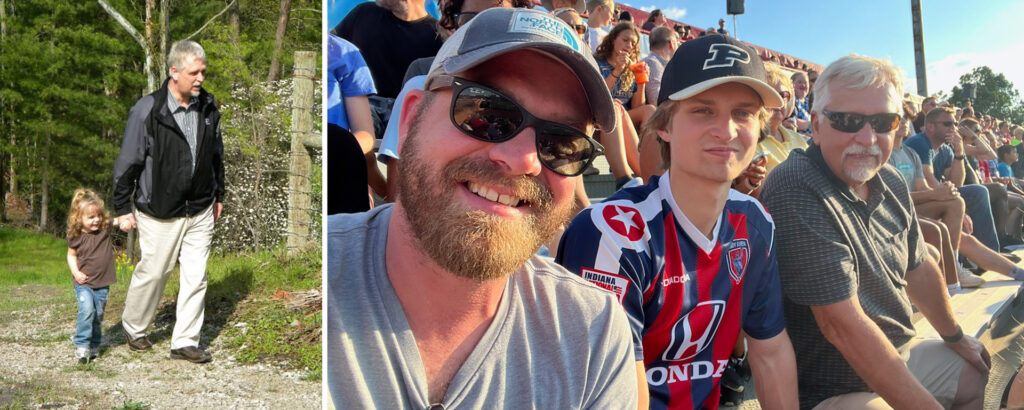
Four months later, Harless had been released to pursue any activities he felt comfortable with. That included volunteering, serving as a church elder, and enjoying his three grandchildren. While a few of his friends completed the project at his daughter’s house, he has home improvements of his own he’ll be tackling this year, but he won’t overdo it this time.
“I want to level out a patio and hire a couple of young pups to help,” he said.
To see any of our world-class subspecialists in brain, spine, or nervous system care, request an appointment today.