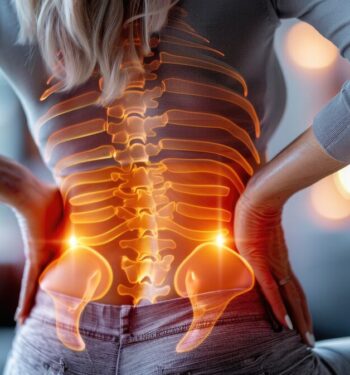
Lower back pain that shoots down your leg can disrupt everything from your morning routine to your sleep quality. If you’re experiencing this combination, understanding your treatment options is the first step toward sciatica pain relief.
Low back pain with sciatica combines pain in your lower back with sciatic nerve pain radiating along the sciatic nerve from your lower back through your hips and down one or both legs. This condition is also sometimes referred to as lumbago with sciatica. When these symptoms occur together, they often signal an underlying issue such as a herniated disc. Goodman Campbell’s team of neurosurgeons, interventional pain management physicians, and health professionals offer comprehensive sciatica and herniated disc treatment that Indiana patients trust.
What Is Low Back Pain With Sciatica?
Low back pain with sciatica combines pain in your lower back and sciatic nerve pain radiating down one or both legs following the sciatic nerve pathway. The sciatic nerve runs from your lower spinal cord through your buttocks and down each leg.
Lower back pain stays localized in the lumbar region. However, sciatica pain, a specific type of radiculopathy, travels beyond your back, often presenting as sharp, burning, or shooting sensations down your thigh to your foot. Many patients describe it as an electric shock that worsens with movement.
This combination indicates something in your lower spine is compressing the nerve roots that form the sciatic nerve.
How Are Low Back Pain and Sciatica Connected?
Your sciatic nerve forms from nerve roots exiting your spinal cord in the lumbar region. When something like a herniated disc puts pressure on these nerve roots, you experience both local back pain and radiating leg pain.
Nerve compression in your lower back affects the entire sciatic nerve pathway. The back pain comes from irritation at the compression site, while sciatica symptoms result from nerve signal disruption traveling down your leg. Treating low back pain with sciatica requires addressing the source of compression in your spine.
How Do You Treat Low Back Pain With Sciatica?
Understanding the cause is one thing, but what patients really want to know is how to find relief. Treatment follows a progressive approach, starting with conservative options and advancing if symptoms persist.
Conservative treatments form the first line of defense: rest modification, anti-inflammatory treatments, and physical therapy to strengthen supporting muscles. Most patients experience significant improvement within six weeks, with symptoms resolving in 60%–80% of cases during this timeframe.
Interventional pain management physicians provide epidural steroid injections to deliver anti-inflammatory medication directly to the compressed nerve area, reducing swelling and pain for weeks to months.
If conservative treatments fail after several months, or if you experience severe symptoms such as progressive weakness or loss of bowel or bladder control, surgical intervention becomes necessary. Your spine specialist will consider options including microdiscectomy to remove herniated disc material, laminectomy to create space around compressed nerves, or spinal fusion for instability.
For patients managing sciatica pain at home between appointments, see our guide on whether it is better to sit or lie down with sciatica.
What Is the Most Successful Treatment for Sciatica Pain?
This leads us to the question most patients eventually ask: if conservative care isn’t working, what gives you the best chance at lasting relief? For patients who don’t find relief through conservative measures, microdiscectomy surgery has the highest success rate to treat sciatica pain caused by herniated discs. This minimally invasive procedure removes the herniated disc portion pressing on your nerve root while preserving healthy disc tissue.
“Most successful” depends on your specific situation. If sciatica results from spinal stenosis, a laminectomy may be more appropriate. For spinal instability, fusion surgery can address both nerve compression and structural problems.
Neurosurgeons complete significantly more extensive training in spinal anatomy and nerve function compared to orthopedic surgeons, making them uniquely qualified for both straightforward and complex spine conditions.
What Causes Low Back Pain With Sciatica?
Several conditions can trigger low back pain and sciatica pain by creating pressure on spinal nerves in your lower back:
- Herniated discs (most common): Soft inner disc material pushes through its outer layer, pressing on nearby spinal nerves and creating both local inflammation and sciatic nerve pain
- Spinal stenosis: Narrowing of the spinal cord canal compresses spinal nerves, producing sciatica pain and muscle weakness in the legs
- Degenerative disc disease: Weakened spinal discs prone to herniation or collapse, increasing spinal nerves irritation and severe pain
- Bone spurs, spondylolisthesis, or spinal tumors: Less frequent causes of spinal nerves compression producing sciatica pain and the need to relieve pressure
Can a Herniated Disc Cause Both Low Back Pain and Sciatica?
Yes, a herniated disc is the leading cause of low back pain with sciatica pain. When disc material herniates, it creates a two-fold problem: local inflammation causing severe pain in the back, and pressure on the nerve roots forming the sciatic nerve, triggering sciatic nerve pain and muscle weakness radiating down the leg. Depending on which nerve root is compressed (L4, L5, or S1), you’ll feel sciatica pain in different areas.
Is Surgery Needed for Low Back Pain With Sciatica?
Surgery isn’t always necessary. Many patients improve with conservative treatment, including physical therapy, medication, and activity modification, with symptoms often resolving within 6–12 weeks.
However, surgery may be recommended in several scenarios. If conservative treatments haven’t produced meaningful improvement after several months, continuing the same approach is unlikely to help. Progressive neurological symptoms—increasing leg weakness, spreading numbness, or foot drop—indicate worsening nerve damage, requiring prompt surgical intervention.
Emergency surgery is necessary if you develop cauda equina syndrome, marked by loss of bowel or bladder control, saddle anesthesia, or severe weakness in both legs. This surgical emergency requires immediate treatment to prevent permanent nerve damage.
When Should You See a Neurosurgeon for Low Back Pain With Sciatica?
Whether your sciatica symptoms are new or ongoing, Goodman Campbell is ready to help. We can start conservative treatment with you or evaluate your progress if prior therapies haven’t provided enough relief. Experts suggest seeing a neurosurgeon if conservative care hasn’t resolved symptoms after four weeks, if weakness or numbness worsens, or if pain continues to interfere with daily function. If conservative treatments like physical therapy haven’t led to the improvement you expected, a neurosurgeon can help guide your next steps.
Contacting our office early offers distinct advantages. We can initiate conservative care and put you on a personalized path to healing as soon as possible. Also, because neurosurgical training is more extensive and specialized for spine conditions, as compared to other providers, a neurosurgeon’s expertise becomes crucial when determining whether surgery is necessary and which procedure will deliver optimal outcomes.
For patients looking to strengthen the spine while managing sciatica pain, see our 5 simple spinal stenosis exercises — many of which are also appropriate for low back pain with sciatic nerve pain.
Goodman Campbell provides each patient with direct access to their neurosurgery care team. As conservative measures are being explored, our neurosurgeons work closely with interventional pain management specialists to reduce inflammation, relieve pain and promote healing. As a global leader in spine care at the center of neurosurgery training, we offer patients treatment from physicians at the forefront of clinical research and surgical innovation.
If you’re experiencing red-flag symptoms, such as loss of bowel or bladder control, progressive leg weakness, or numbness spreading into both legs, seek immediate evaluation.
Expert Herniated Disc Treatment Indiana Patients Trust
Low back pain with sciatica responds best when treated by specialists who understand both immediate symptom relief and long-term spine health. Goodman Campbell’s neurosurgery and interventional pain management care teams combine world-class expertise with personalized, patient-centered care.
Whether you need conservative management or advanced surgical intervention, you’ll receive treatment from specialists whose training and proven outcomes set us apart. Contact Goodman Campbell to schedule an appointment and take the first step toward lasting relief from your lower back pain and sciatica symptoms.