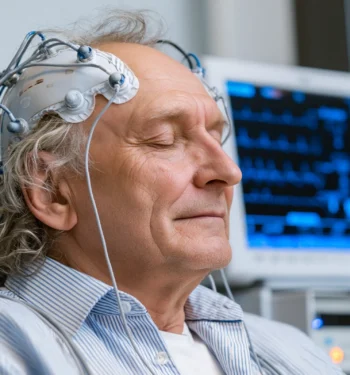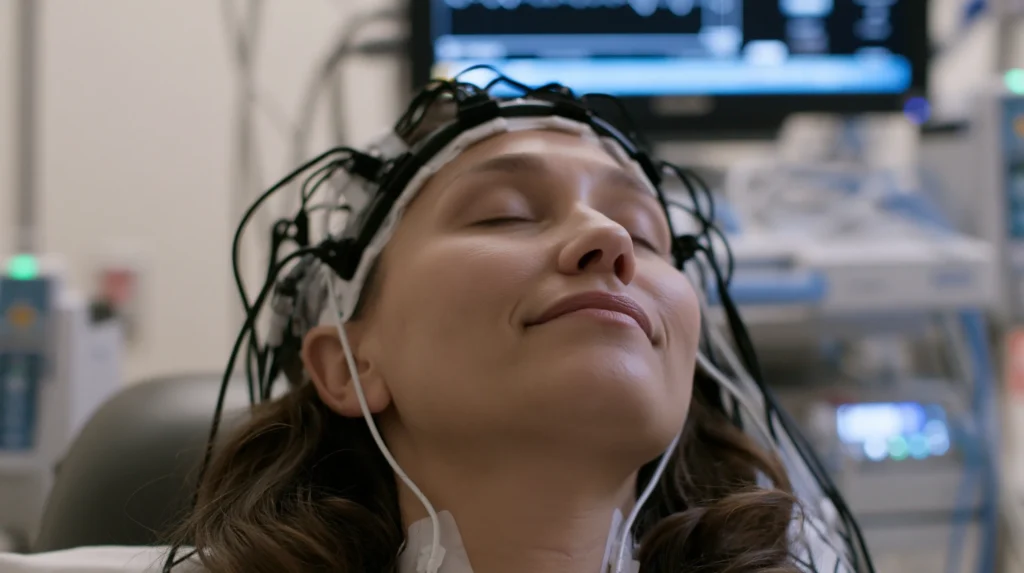
For many patients, DBS for Parkinson’s treatment can be life-changing when motor symptoms begin interfering with daily life in increasingly significant ways. While deep brain stimulation for Parkinson’s is not a cure, it has been shown to meaningfully improve tremor, stiffness, slowness, and overall quality of life for patients who are good candidates.
What Does Deep Brain Stimulation Actually Do for Parkinson’s?
Deep brain stimulation works by placing thin electrodes into highly specific areas of the brain, most commonly the subthalamic nucleus or globus pallidus internus. These electrodes deliver carefully controlled electrical pulses that help regulate the abnormal brain activity associated with Parkinson’s disease, improving many of the motor symptoms such as tremor, stiffness, slowed movement, and involuntary movements (dyskinesias).
It’s important to understand that DBS addresses dysfunction within the brain’s circuitry; it is not simply masking symptoms. That said, DBS does not stop Parkinson’s disease progression or cure the condition. Instead, studies indicate it can significantly improve symptom control and help patients maintain independence and daily function for longer.
Who Is a Good Candidate for DBS Surgery?
Strong DBS surgery candidates typically have a confirmed Parkinson’s diagnosis, worsening motor symptoms that are becoming more difficult to manage, preserved cognitive function, and a history of responding well to prior dopaminergic therapy (a positive drug response is generally considered to be a meaningful signal of likely surgical success). Common DBS candidate criteria include tremor, stiffness, or slowness that meaningfully affects quality of life despite ongoing treatment efforts.
Our evaluation process is intentionally extensive. Determining candidacy involves neurological testing, imaging, cognitive assessment, and detailed conversations about goals, expectations, and risks. We generally recommend evaluation before quality of life declines substantially, rather than waiting until symptoms become severely disabling.
Is It Possible to Have DBS Too Early or Too Late?
Yes, timing matters.
In 2016, the FDA expanded approval for DBS to include earlier-stage Parkinson’s disease, recognizing that patients do not need to wait until symptoms become extreme before considering surgery. In fact, waiting too long can sometimes limit potential surgical benefit, particularly if significant balance problems or cognitive decline develop later in the disease course.
Studies on DBS long-term outcomes suggest that proactive timing often supports stronger long-term function and independence.
What Are the Risks and Limitations of DBS?
Like any brain procedure, DBS carries real risks. Potential DBS risks and side effects include infection, bleeding, lead displacement, or device-related complications that may require adjustment or revision.
It is also important to understand what DBS does not treat especially well. DBS is typically less effective for balance difficulty, freezing of gait, or non-motor symptoms. Patients with significant dementia or cognitive impairment are generally not ideal candidates.
One major advantage of DBS, however, is that it is adjustable and reversible. Unlike ablative procedures that permanently destroy brain tissue, DBS settings can be modified over time as symptoms evolve.
How Long Do the Benefits of DBS Last?
Research on DBS success rate and long-term effectiveness is encouraging. A study in the Journal of Neurosurgery reports that DBS provides durable relief from symptoms, with some patients maintaining functional improvement beyond 10 years.
While Parkinson’s disease continues progressing over time, DBS can support activities of daily living well into later stages of the condition. Long-term patient satisfaction remains consistently high in many published studies.
Why Does Your Neurosurgical Team Matter for DBS Outcomes?
At Goodman Campbell Brain and Spine, we know how much precision matters. As a global leader in brain and spine care with a mission that revolves around clinical research and continually pursuing better outcomes for patients, we specialize in highly advanced functional neurosurgery procedures such as DBS.
We perform asleep DBS surgery using advanced MRI-guided technology while patients remain under anesthesia, with CT confirmation of lead placement before patients wake.
Most importantly, our patients and referring physicians have direct access to our team throughout the process, ensuring that questions are answered promptly, care remains highly coordinated, and patients feel supported at each and every stage of treatment.
To learn more about candidacy, visit our Parkinson’s Disease page. For an evaluation request an appointment with Goodman Campbell functional neurosurgeon Mark Hoeprich, MD, by calling 317-338-9660. Dr. Hoeprich sees patients at Ascension St. Vincent – Indianapolis Functional Neurosurgery.n team, led by functional neurosurgeon Mark Hoeprich, MD, performs DBS with the patient fully asleep using advanced computer-guided technology. As a global leader in neurosurgery treating patients for more than 50 years, we are proud to help patients pursue safer, more effective care close to home.
If you would like to learn whether DBS may be right for you, we encourage you to request an appointment with Dr. Hoeprich by calling 317-338-9660. today.