By Vince Alentado, MD, Neurosurgeon, Spine Specialist
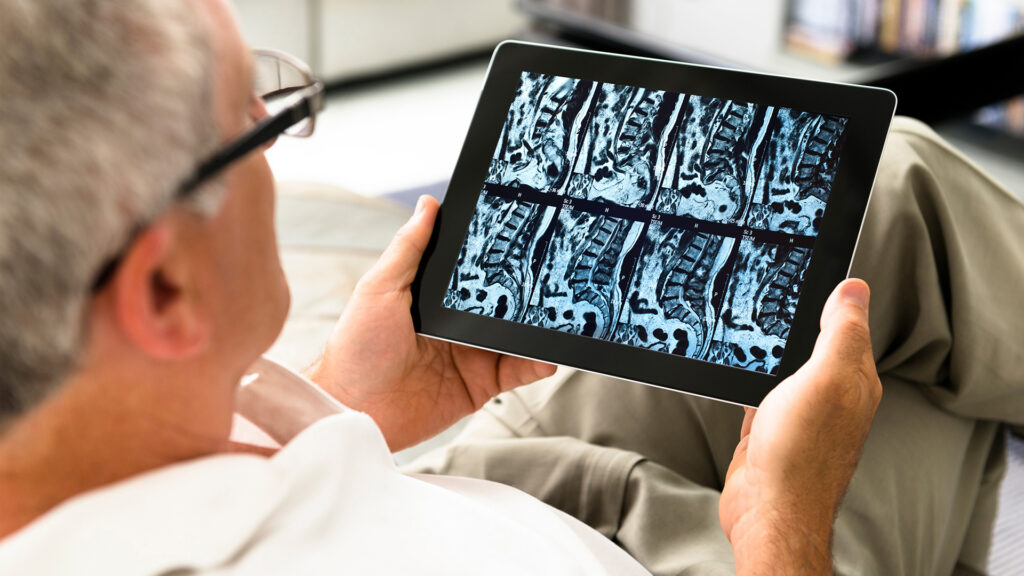
Around the time of the COVID-19 pandemic, patients gained unprecedented access to their medical records through electronic medical record patient portals. While this increased transparency and patient engagement is unquestionably valuable, it has also changed the way many patients approach their medical care.
Before widespread access to radiology reports, a patient with an MRI would typically come to the office with a constellation of symptoms, and the neurosurgeon would review the imaging in the context of the patient’s history and examination. Increasingly, patients began arriving to clinic having already read the radiology report — and often with significant anxiety about findings that may be incidental or clinically insignificant. I have seen dozens of patients who are asymptomatic but seek a neurosurgical consultation because of something concerning they read in an MRI report.
More recently, patients have taken this a step further by placing their radiology reports into their preferred artificial intelligence (AI) platform. As a result, patients are arriving with preconceived notions about what is happening with their spine, and they may also come with a list of AI-generated questions. I recently saw an 89-year-old patient who arrived with a detailed list of questions generated by ChatGPT.
AI undoubtedly has tremendous potential to improve healthcare, and patients should have meaningful access to their medical information. However, there is a risk that the abundance of information can inadvertently take some of the humanity out of the patient encounter. Instead of beginning with the patient’s symptoms, concerns, and examination and then using our neurosurgical expertise to interpret the imaging in that context, the conversation can become centered on what the MRI “shows.”
This is particularly important with degenerative spine imaging. Incidental degenerative findings are extremely common, even among healthy, asymptomatic individuals. Studies have demonstrated that by their 30s, approximately half of patients have evidence of disc degeneration, about one-third have disc height loss, and a substantial proportion have disc bulging. Radiology reports necessarily document many of these abnormalities, sometimes creating a lengthy list of findings that may have little or no clinical relevance to the patient’s symptoms. When an AI system then interprets a radiology report without the benefit of the patient’s history, physical examination, and clinical context, we can quickly arrive at a “garbage in, garbage out” scenario.
This expanding access to information places an additional burden on referring providers. Patients who become anxious after reading their radiology reports — or an AI-generated interpretation of those reports — may reach out to their primary care providers with questions and concerns before anyone has had the opportunity to put the findings into perspective.
For this reason, I believe it is increasingly important for referring providers to recognize the difference between common, benign radiographic findings and imaging abnormalities that warrant further evaluation. It is also worth considering early neurosurgical referral when advanced imaging is performed. Our role as neurosurgeons is not simply to interpret an MRI. It is to synthesize the patient’s history, symptoms, examination, imaging, and individual goals to determine what — if anything — needs to be done. In some cases, our most important contribution may be reassuring a patient that the frightening language in a radiology report does not represent a dangerous condition or a need for surgery.
As I tell my patients every day: We treat people, not pictures.
In an era of unprecedented access to medical information and increasingly sophisticated AI tools, I believe that principle is more important than ever. Rather than viewing AI as a replacement for clinical expertise, we should use it as a tool while ensuring that patients ultimately receive what an AI algorithm cannot provide: context, judgment, reassurance, and a human connection with their physician.
Learn more about neurosurgeon and spine specialist Vince Alentado, MD, who sees patients at Goodman Campbell – Noblesville. New patients can request an appointment online or call 317-396-1300.