Persistent neck pain, arm pain, numbness, tingling, or weakness can make everyday activities difficult. When these symptoms are caused by a damaged disc or compression of the nerves or spinal cord, and nonsurgical treatment hasn’t provided adequate relief, ACDF surgery may be an option.
For some people, cervical spine symptoms can affect much more than comfort. Pain or weakness may interfere with work, sleep, exercise, or everyday tasks, while spinal cord compression can contribute to problems with balance, coordination, or hand function. When symptoms persist or neurological changes develop, identifying and addressing the underlying cause becomes particularly important. Over time, these symptoms may increasingly affect mobility, independence, and quality of life.
Surgery is not necessary for every cervical spine condition, but for appropriately selected patients, it may provide a way to relieve structural compression and protect neurological function.
Anterior Cervical Discectomy and Fusion (ACDF) is a commonly performed cervical spine procedure designed to address the structural source of nerve or spinal cord compression. If you are considering surgery, understanding how ACDF works, who may benefit, and what ACDF surgery recovery involves can help you make a more informed decision about your care.
What Is ACDF Surgery?
ACDF is a procedure used to remove a damaged or degenerative disc in the cervical spine, or neck, and relieve pressure on nearby nerves or the spinal cord.
During surgery, the neurosurgeon reaches the cervical spine through a small incision in the front of the neck. This anterior approach allows access to the affected disc without cutting through the larger muscle groups in the back of the neck or approaching the spinal cord from behind.
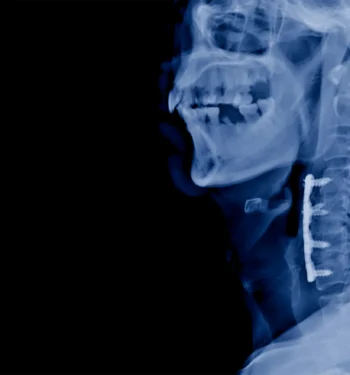
Once the damaged disc is removed, the neurosurgeon carefully removes the disc material or bone spurs causing compression. A bone graft and/or interbody spacer is then placed in the disc space to maintain proper spacing and alignment and promote fusion between the vertebrae. Additional hardware, such as a plate and screws, may be used to provide stability while the bones fuse.
Unlike treatments intended primarily to manage symptoms, ACDF is designed to address the underlying structural problem causing nerve or spinal cord compression. By removing the damaged disc and other material pressing on these structures, the procedure creates more space for the affected nerves or spinal cord. The fusion portion of ACDF then helps stabilize the treated area as the vertebrae heal together. For appropriately selected patients, this combination of decompression and stabilization can help address the source of symptoms such as radiating arm pain, numbness, tingling, or weakness, rather than focusing solely on managing those symptoms.
What Conditions Does ACDF Surgery Treat?
ACDF may be recommended for several conditions affecting the cervical spine, including:
- Cervical disc herniation: A damaged disc can bulge or rupture, putting pressure on a nearby nerve or the spinal cord.
- Degenerative disc disease: Age-related changes can cause cervical discs to lose height or deteriorate, potentially contributing to instability or compression.
- Cervical radiculopathy: A compressed nerve root can cause pain, numbness, tingling, or weakness that travels from the neck into the shoulder, arm, or hand. When nonsurgical cervical radiculopathy treatment is unsuccessful, surgery may be considered.
- Cervical myelopathy: Compression of the spinal cord can affect balance, coordination, walking, hand function, and other neurological abilities. Cervical myelopathy surgery may be recommended to relieve this pressure and help prevent further neurological decline.
- Bone spurs: Arthritic changes can cause extra bone to develop around the vertebrae and joints, narrowing the space available for nerves or the spinal cord.
When structural compression is present, ACDF can physically remove the source of that compression. Interventional pain techniques may help manage certain symptoms in appropriately selected patients, but they do not remove spinal cord compression or treat cervical myelopathy.
Is ACDF Surgery the Same as Other Cervical Spine Surgeries?
ACDF is one of several procedures neurosurgeons can use to treat cervical spine conditions.
Posterior cervical decompression and fusion approaches the cervical spine from the back of the neck and may be appropriate when compression, instability, or disease involves multiple areas. A minimally invasive posterior discectomy also approaches from the back and can relieve certain types of nerve compression without fusion.
Another option is artificial cervical disc replacement. While ACDF removes the damaged disc and fuses the surrounding vertebrae, artificial disc replacement uses an implant designed to preserve motion at the treated level. When comparing ACDF vs. disc replacement, the appropriate choice depends on factors such as the location and extent of the damage, the number of affected levels, spinal stability, and the patient’s individual anatomy.
There is no single best procedure for every patient. The location of compression, number of affected levels, spinal alignment, overall health, and other factors all influence which approach may be appropriate. At Goodman Campbell, our neurosurgeons perform multiple cervical spine approaches, allowing us to recommend the procedure that is best suited to each patient’s specific anatomy and condition. Rather than taking a one-size-fits-all approach, we evaluate the underlying cause and location of the problem, among other factors, to determine which surgical option may provide the most appropriate path forward.
Who Is a Candidate for ACDF Surgery?
ACDF surgery candidates typically have a cervical spine condition that is causing persistent symptoms or neurological changes and can be clearly identified through imaging and a neurological evaluation.
Surgery may be considered when:
- Neck or radiating arm symptoms continue despite an appropriate course of nonsurgical treatment
- Physical therapy or physical therapy-based rehabilitation has not provided adequate improvement
- Interventional pain management has not provided sufficient symptom relief for conditions appropriately treated with these approaches
- Weakness, numbness, or other neurological symptoms are progressing
- Imaging shows a herniated disc, bone spur, or another structural problem compressing a nerve or the spinal cord
- Imaging and symptoms indicate spinal cord compression or cervical myelopathy
You can learn more about the different surgical approaches in our Guide to Spine Surgery for a Cervical Herniated Disc.
Ultimately, determining candidacy requires an individualized evaluation. A neurosurgeon can review your symptoms, imaging, health history, and response to previous treatment before recommending the appropriate next step.
When Is It Time to Consider Surgery Over Conservative Treatment?
Many cervical spine conditions are initially treated without surgery. When symptoms are manageable and there is no significant or progressive neurological impairment, nonsurgical care may provide adequate relief.
Surgery becomes a more important consideration when symptoms continue despite appropriate conservative care or begin to interfere substantially with everyday life. Progressive neurological changes, including worsening weakness, numbness, hand coordination problems, or difficulty with balance or walking, can also indicate a need for prompt evaluation.
Imaging is another important part of this decision. If scans show a structural abnormality that corresponds with your symptoms, surgery may provide a way to directly address the source of the problem.
This distinction is particularly important when spinal cord compression is present. Spinal cord compression surgery is designed to physically relieve pressure on the spinal cord. The goal is not simply to mask symptoms, but also to address the structural cause and, when possible, protect neurological function.
What Happens During ACDF Surgery?
Although every surgical plan is individualized, the basic ACDF procedure steps generally include:
- Anesthesia: ACDF is performed under general anesthesia.
- Anterior incision: The neurosurgeon makes a small incision in the front of the neck.
- Accessing the cervical spine: Structures in the neck are carefully moved aside to provide access to the affected vertebrae and disc.
- Removing the damaged disc: The neurosurgeon removes the damaged disc to create access to the areas requiring decompression.
- Decompression: Disc material, bone spurs, or other tissue pressing on the nerve roots or spinal cord are carefully removed to relieve compression.
- Restoring the disc space: A bone graft and/or interbody spacer is placed in the space where the disc was removed to maintain disc height and alignment and provide a setting for fusion.
- Stabilization: Depending on the surgical technique and implant used, a plate and screws or other fixation may be used to stabilize the treated segment while fusion occurs.
- Closing the incision: Once the reconstruction is complete, the incision is closed.
You can find additional information about the procedure on our Anterior Cervical Decompression and Fusion procedure page.
ACDF single and multilevel surgeries follow the same general principles. A single-level procedure treats one disc space, while multilevel ACDF addresses two or more. The number of levels involved can affect surgical time, recovery, and the overall treatment plan.
Most ACDF procedures can be performed on an outpatient basis, allowing patients to return home the same day. Individual circumstances may require an overnight stay or additional observation.
How Long Does ACDF Surgery Take?
The answer depends on the number of levels being treated, the complexity of the compression, the patient’s anatomy, and whether additional reconstruction is necessary.
Many ACDF procedures take approximately 1 to 3 hours, with single-level procedures generally requiring less time than more complex multilevel surgeries.
Keep in mind that the time spent in the operating room is only part of your surgical day. Preoperative preparation, anesthesia, and postoperative monitoring in the recovery area add additional time. Your neurosurgeon can give you a more individualized estimate based on your planned procedure.
What Does ACDF Surgery Recovery Look Like?
Your ACDF recovery timeline begins immediately after surgery. Most patients are able to return home the same day, although this varies according to the procedure and individual health needs.
During the first several days and weeks, some discomfort and stiffness around the neck and surgical site are expected. Temporary swallowing difficulty or throat irritation can also occur because of the anterior surgical approach.
Your care team will provide specific instructions about activity, neck positioning, lifting, driving, incision care, and other restrictions. Walking and gradually increasing activity are often important parts of early ACDF surgery recovery, but it is essential to follow the recommendations provided by your surgical team rather than advancing activity too quickly.
Return to light or desk-based work varies. Some patients may return within approximately 2 to 6 weeks, depending on how well they are recovering and the physical demands of their job. More strenuous work may require additional time.
Physical therapy, when needed, may begin around 6 weeks after surgery or at another point recommended by your neurosurgeon. Not every patient will require the same rehabilitation plan.
It is also important to distinguish feeling better from being fully healed. The fusion process continues long after the incision heals. Bone fusion may take approximately 3 to 12 months to complete.
Your personal recovery may differ based on your age, overall health, the number of levels treated, the complexity of surgery, and how closely you follow postoperative recommendations.
What Are the Risks and Possible Complications of ACDF Surgery?
Every surgical procedure carries potential risks. Understanding ACDF surgery risks can help you have a more informed conversation with your neurosurgeon and weigh the potential benefits against the possible complications.
Potential risks and side effects can include:
- Temporary difficulty swallowing, also called dysphagia
- Temporary hoarseness or voice changes
- Infection
- Rare nerve injury
- Incomplete fusion, or pseudoarthrosis
- Adjacent segment disease, in which the spinal levels above or below the fusion experience changes over time
Some patients also experience temporary neck, shoulder, or arm symptoms as tissues heal and previously compressed nerves recover.
ACDF has a long history of use in cervical spine surgery and a well-established safety profile when performed for appropriate indications. Your individual risks, however, depend on factors such as your overall health, diagnosis, anatomy, and the complexity of the procedure.
An experienced neurosurgical team can help you understand these risks in the context of your specific condition rather than relying solely on general statistics.
Why Does Surgeon Expertise Matter for ACDF Surgery?
ACDF takes place close to the spinal cord, nerve roots, major blood vessels, and other important structures in the neck. For that reason, the training and experience of the surgical team are extremely important.
When choosing a neurosurgeon for ACDF, consider not only whether a surgeon regularly performs the procedure, but also whether the team has experience managing the full spectrum of cervical spine disease. Both simple and complicated cases require the same careful understanding of spinal anatomy, neurological function, imaging, and surgical decision-making.
At Goodman Campbell, our neurosurgeons treat both straightforward and highly complex spine conditions, allowing patients to receive specialized care even when their diagnosis or anatomy requires a more advanced approach.
Patients and referring physicians also have direct access to their Goodman Campbell team. Prompt appointment availability can help patients move efficiently from evaluation toward answers and, when appropriate, treatment.
What Sets A Neurosurgeon Apart for Cervical Spine Surgery?
Neurosurgery training is particularly extensive and specialized, with deep emphasis on the brain, spinal cord, nerve roots, and other structures of the nervous system. This training provides an important foundation for procedures such as ACDF, where relieving pressure on delicate neurological structures is a central goal of surgery.
Orthopedic surgeons also receive surgical training involving the musculoskeletal system and may pursue additional spine specialization. Neurosurgical training, however, involves more extensive and specialized training focused specifically on the nervous system, including the spinal cord and nerve structures involved in cervical spine surgery.
Goodman Campbell is a global leader in neurosurgery, neurosurgical training and clinical research. Our experience extends across the spectrum of brain and spine conditions, allowing us to bring that depth of expertise to each patient’s evaluation and surgical plan.
Are You a Potential Candidate for ACDF Surgery?
Living with persistent neck or arm pain, numbness, tingling, weakness, or other neurological symptoms can leave you wondering whether surgery is the appropriate next step. The answer depends on much more than a single symptom or imaging result.
At Goodman Campbell, we evaluate each patient individually, taking into account your diagnosis, symptoms, imaging, overall health, and previous treatment. Whether your condition is straightforward or highly complex, you have access to a globally recognized neurosurgery team with extensive experience treating disorders of the spine and nervous system. Efficient scheduling helps you move from uncertainty toward answers and an individualized treatment plan.
For most patients, the first step is not necessarily deciding whether to have surgery, but rather, understanding what is causing their symptoms and which treatment options make sense for their specific condition. A thorough evaluation can help determine whether ACDF, another cervical spine procedure, or a nonsurgical approach may be appropriate, while giving you the opportunity to ask questions about potential benefits, risks, recovery, and what you can realistically expect from treatment.
If you are experiencing cervical spine symptoms, we can help you understand your diagnosis and treatment options. Call 317-396-1300 to speak with our team or request an appointment online.