If tremors have begun interfering with your ability to write, eat, work, or maintain your independence, you may be wondering whether newer treatment options exist beyond traditional surgery. Today, the list of MRI-guided focused ultrasound conditions treated includes essential tremor and tremor-dominant Parkinson’s disease. This noninvasive approach is changing how we think about functional neurosurgery tremor care.
MRI-guided high-frequency focused ultrasound offers an incisionless way to target the abnormal brain activity responsible for tremors without implants or open surgery.
What Is MRI-Guided Focused Ultrasound and How Does It Work?
MRI-guided focused ultrasound, sometimes called MRgFUS, is a noninvasive, incisionless procedure used to treat tremors. It uses highly focused sound waves to precisely target a small area within the brain. Unlike traditional diagnostic ultrasound, this technology uses high-intensity energy designed specifically for treatment.
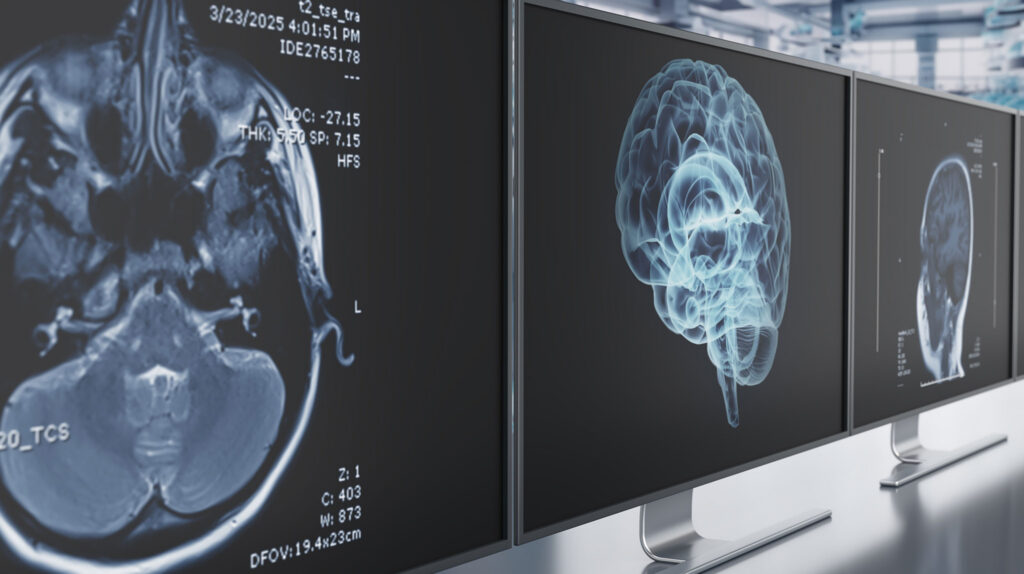
Real-time MRI imaging allows our neurosurgeon to identify the exact treatment target while also monitoring tissue temperature throughout the procedure for precision and safety. No incisions, implants, or general anesthesia are required.
For patients exploring focused ultrasound for tremors, the appeal is often straightforward: treatment without open brain surgery.
How Is MRI-Guided Focused Ultrasound Different From Deep Brain Stimulation?
Deep brain stimulation requires implanted electrodes and surgical hardware. MRI-guided focused ultrasound for tremor treatment requires no craniotomy, no implanted devices, and no overnight hospital stay.
Patients remain awake during treatment and can communicate with the physician in real time. Most people return home the same day and resume normal activities within days, making it an appealing alternative to deep brain stimulation for appropriately selected patients.
What Conditions Is MRI-Guided Focused Ultrasound FDA Approved to Treat?
MRI-guided focused ultrasound (MRgFUS) is FDA approved for the treatment of certain movement disorders, including essential tremor and specific symptoms associated with Parkinson’s disease.
For essential tremor, MRgFUS is used for patients with tremors who have not responded adequately to medication or who cannot tolerate medication. The procedure targets the ventral intermediate nucleus (VIM) of the thalamus, an area involved in regulating movement signals. By creating a precise, targeted lesion, MRgFUS can disrupt abnormal brain activity associated with tremor.
MRgFUS is also FDA approved for certain patients with Parkinson’s disease. Procedure types include unilateral treatment of tremor associated with Parkinson’s disease and unilateral pallidotomy for Parkinson’s disease patients with symptoms such as dyskinesia and motor fluctuations.
Who Is a Good Candidate for MRI-Guided Focused Ultrasound?
General MRgFUS candidacy requirements include:
- A confirmed diagnosis of essential tremor or tremor-dominant Parkinson’s disease
- Tremors that significantly affect daily life and activities
- Prior treatment that has not provided adequate relief
- Tremors that have not improved adequately with medication or an intolerance to medications
Some patients may not qualify, including those unable to undergo MRI due to certain implants (e.g., pacemakers or certain metallic implants), difficulties with severe claustrophobia, pregnancy, or specific skull anatomy considerations. The best way to determine candidacy is through a personalized consultation with a functional neurosurgery specialist.
What Can Patients Expect Before, During, and After the Procedure?
Before treatment, patients undergo imaging and a comprehensive evaluation to confirm candidacy for MRI-guided focused ultrasound. On the day of treatment, the head is shaved, a lightweight frame is put around the head to help guide treatment, and MRI imaging is used to identify the precise treatment target.
The treatment process typically takes several hours, often 3–4 hours from preparation through completion. Patients remain awake during the procedure while the surgery team uses MRI guidance to deliver carefully controlled ultrasound energy monitor treatment effects, including tremor improvement in real time.
Many patients experience improvement in tremor symptoms immediately after this incisionless tremor treatment and are able to return home the same day. Results are often long-lasting, though every patient’s experience is unique.
How Can Goodman Campbell Help You Explore MRI-Guided Focused Ultrasound?
At Goodman Campbell Brain and Spine, our functional neurosurgeon specializes in advanced functional neurosurgery procedures. As a global leader in neurosurgery, clinical research and training, we are proud to offer essential tremor treatment options and MRI-guided high-frequency focused ultrasound in Indianapolis. Our approach is centered on identifying and treating the root cause of tremors, rather than simply managing symptoms, helping patients pursue meaningful, long-term improvement in daily life.
Patients and referring physicians have direct access to the Goodman Campbell team, allowing for close collaboration and streamlined communication throughout the process.
To learn more about focused ultrasound and candidacy, request an appointment with Goodman Campbell functional neurosurgeon Mark Hoeprich, MD, by calling 317-338-9660. Dr. Hoeprich sees patients at Ascension St. Vincent – Indianapolis Functional Neurosurgery. request an appointment with Dr. Hoeprich, call 317-338-9660.